June 2026
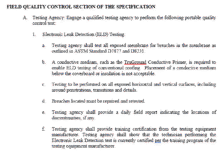
Electronic Leak Detection (ELD) involves non-destructive testing methods that use an electrical current to locate breaches and seam voids in roofing and waterproofing membranes. It is an excellent option for quality control in new construction and for forensic testing to trace active leaks in existing buildings.
ELD is based on well-established scientific principles. When those principles are ignored, the result is invalid testing, missed breaches, and compromised quality assurance. It is the responsibility of every ELD testing agency to comply with the science and adhere to the requirements, and limitations of their chosen methodology as outlined in ASTM D7877 (Standard Guide for Electronic Methods for Detecting Leaks)
Understanding the Four ELD Methods
The four ELD testing methods are defined in ASTM D7877. While they vary in application, all methods share the same foundational requirements. Without these three conditions, valid ELD testing cannot occur.
-The substrate directly beneath the membrane must be electrically conductive (structural concrete or an added conductive medium) for QC/QA as part of new construction.
-A proper ground connection to that substrate must be established.
-The membrane must be exposed.
High Voltage (HV) ELD aka Spark Testing / Holiday Testing
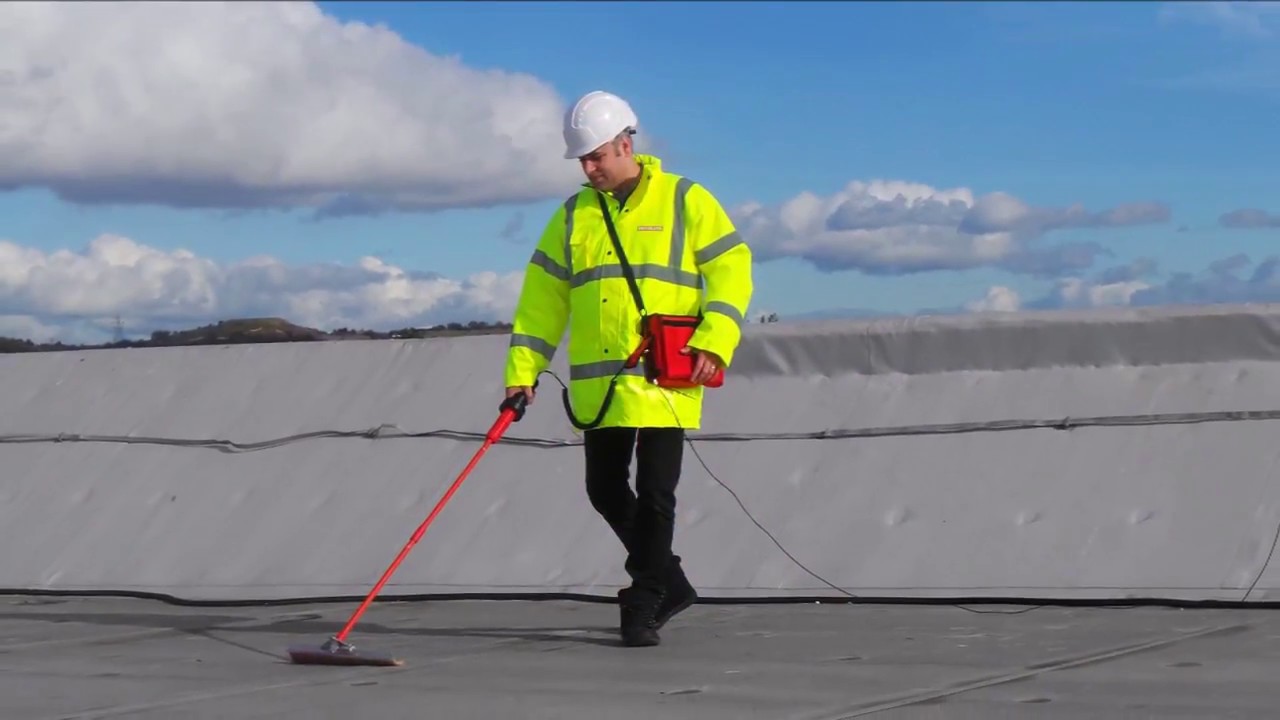
High voltage ELD requires a completely dry membrane surface, which can be a significant limitation in wet climates or during certain seasons.
Additional considerations:
-Equipment’s voltage must be calibrated to membrane thickness.
-Insufficient voltage may miss breaches.
-Excessive voltage may damage the membrane.
-Unable to test semi conductive membranes such as black EPDM.
-Less effective at accurately identifying seam voids.
-Technicians must adhere to rigorous safety standards to avoid severe electric shock, or electrocution.
While HV ELD testing may detect thin spots, ASTM defines a breach as a defect that allows surface water to reach the substrate below. A thin area is not necessarily a breach. Therefore, detecting thin spots does not automatically confirm water migration potential.
Low Voltage (LV) ELD Methods
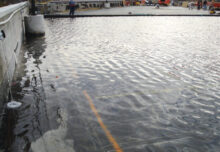
Low voltage methods require a wet membrane surface, which may present challenges on projects with limited water access. ASTM D7877 lists three LV methods:
Low Voltage Vector Mapping

This method requires a perimeter cable to isolate the test area. Within that area:
-Electrically grounded penetrations (e.g., drains) must also be isolated to prevent false positives.
-Transitions, details, and penetrations are excluded from testing.
-Unable to accurately identify breaches in vertical surfaces.
-A continuous layer of water is required within the entire perimeter wire. Gaps in water coverage interrupts the electrical path.
Additional Considerations:
-Set-up time can be lengthy to isolate all the test areas.
-Closely spaced breaches may not be individually identified.
-Unable to test critical areas such as transitions, details, penetrations and verticals.
-Unable to test semi-conductive membranes such as black EPDM.
Vector mapping evaluates the voltage differential across the entire isolated area. If water coverage is inconsistent, breaches can be missed.
Low Voltage Scanning Platform
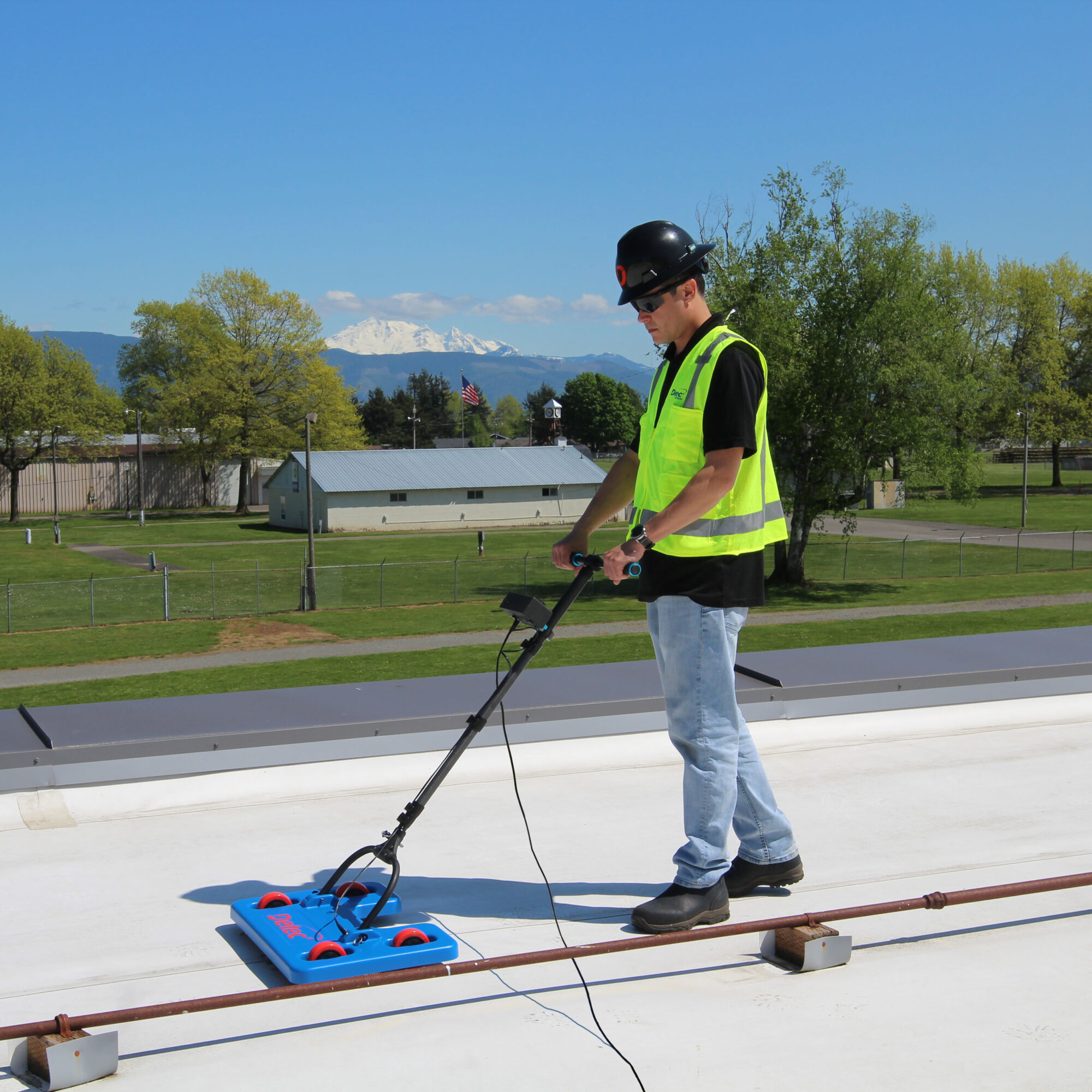
The scanning platform isolates a small test area and is wheeled across wet horizontal surfaces. When an electrical path to ground exists, the equipment provides an audible and visual alert.
Additional Considerations:
-Virtually no set-up time.
-Tests 100% of exposed horizontal membrane.
-Only method capable of testing semi-conductive membranes such as black EPDM.
-Pinpoints breach locations.
-Able to test details, seam voids, and around drains.
-Approved for FM insured projects.
-Basis of design for ASTM D8231 (Standard Practice for the Use of a Low Voltage Electronic Scanning System).
Low Voltage Vertical Roller
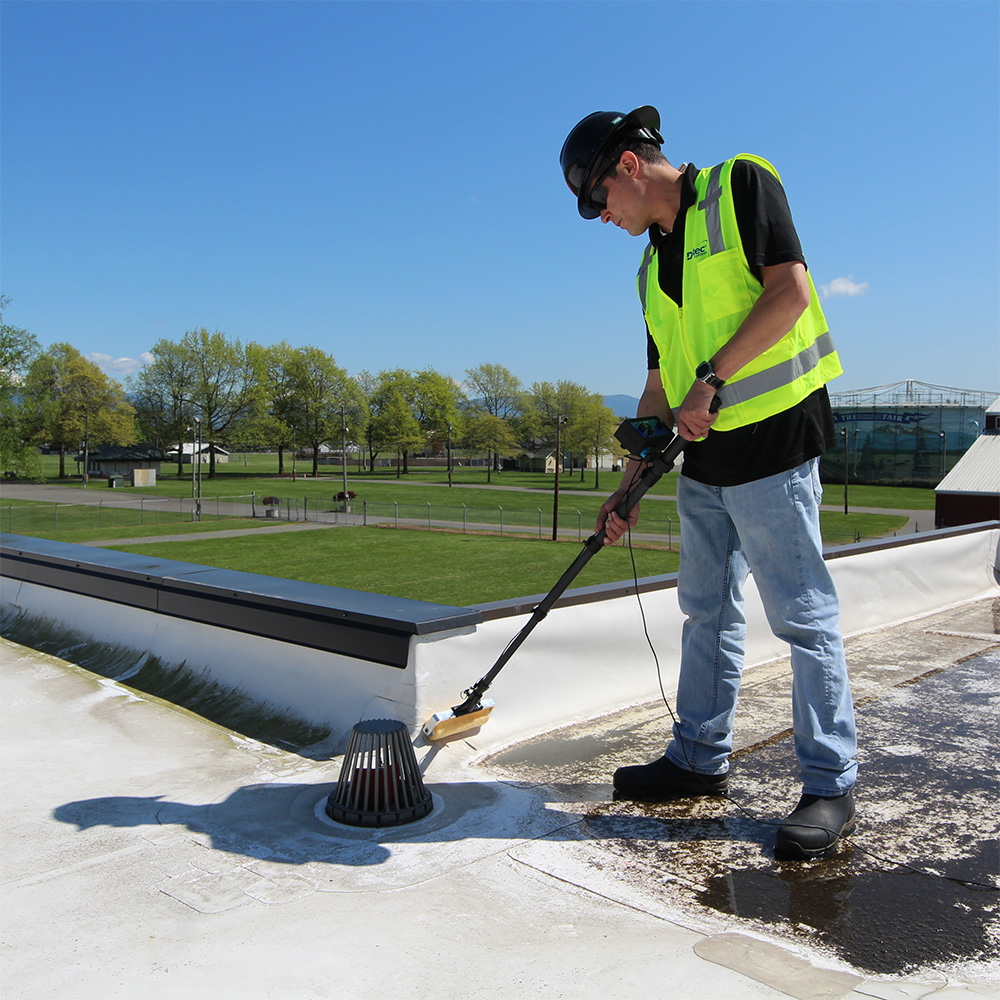
The vertical roller is saturated with water and applied directly to verticals, transitions, penetrations, and detailed areas.
Additional Considerations:
-Able to test vertical surfaces as well as small horizontal areas.
-Only suitable for non-conductive membranes.
-Approved for FM insured projects.
-Basis of design for ASTM D8231.
-Essential for ensuring 100% exposed membrane coverage including verticals when combined with the scanning platform.
FALSE CLAIMS
#1 False Claim: Vector Mapping Can Test Semi-Conductive Membranes
Semi-conductive membranes include black EPDM as well as some cold fluid applied coatings containing carbon black or a high moisture content. Some vector mapping testing agencies claim their equipment can be used if an “insulating adhesive” is present beneath the membrane.
This contradicts science.
ELD requires a conductive path to ground. An insulating adhesive blocks electrical flow and cannot create the required conductive substrate. The conductivity of the membrane surface remains unchanged regardless of adhesive type. Vector mapping cannot test semi-conductive membranes as the equipment cannot differentiate between a conductive membrane, or a breach. The equipment would be consistently grounded out.
FACT: Detec Systems scanning platform is the ONLY ELD method capable of testing semi-conductive membranes such as black EPDM, and this is confirmed in ASTM D8231.
#2 False Claim: A Conductive Medium Is Not Required for Testing Conventional Roofs
Some testing agencies claim ELD can be performed on new conventional roofs without adding a conductive medium. Common justifications include:
-Relying on fasteners in mechanically attached systems.
-Performing capacitance or impedance testing prior to ELD.
Both claims are flawed.
Fasteners are only effective if water reaches them. If water does not migrate from the breach to a fastener, the breach will go undetected.
Capacitance testing identifies trapped moisture—not an electrical path to a grounded object (aka breach), so it does not pinpoint the breach.
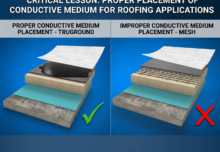
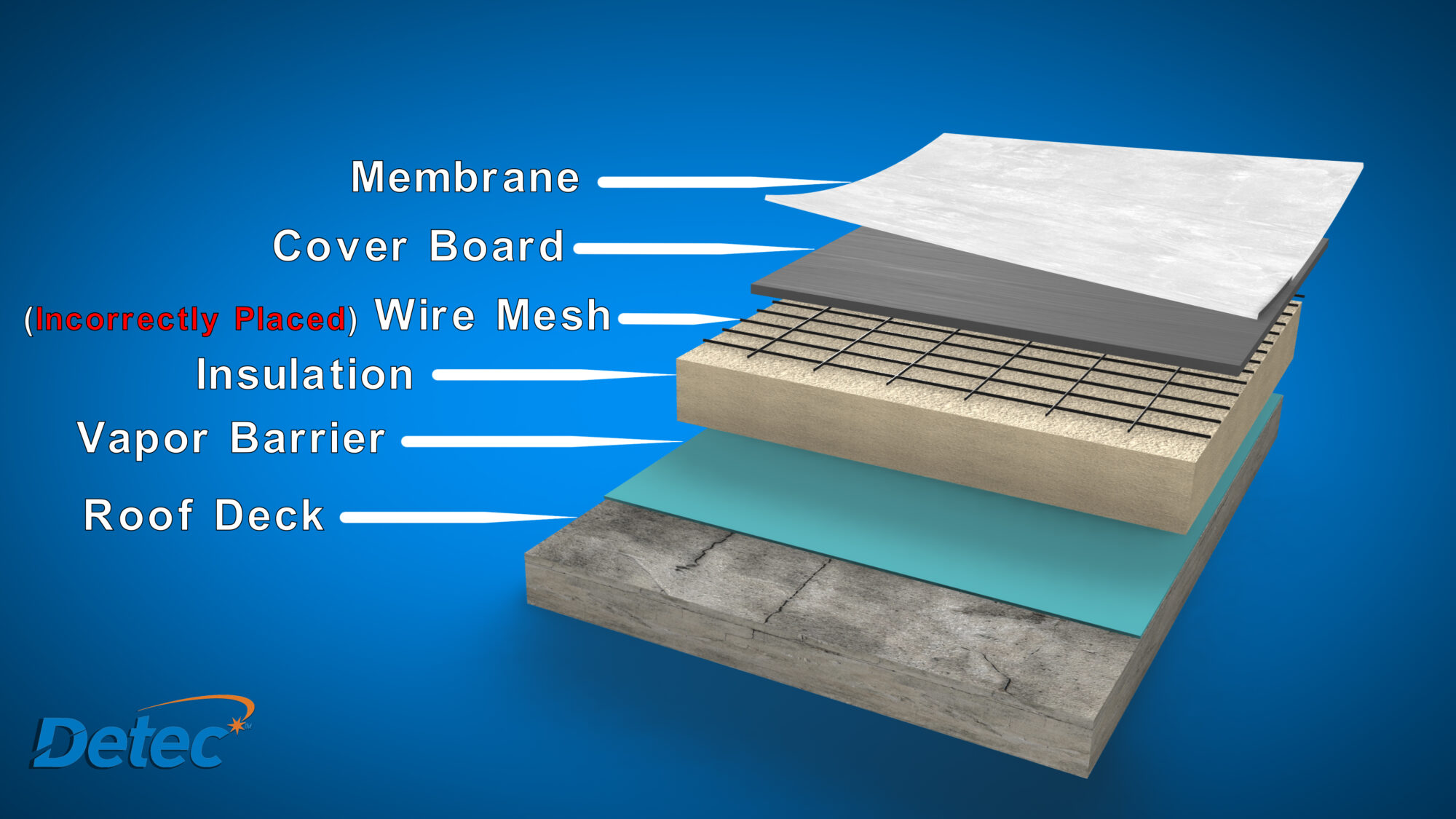
ASTM D7877 clearly states that a conductive substrate must be located directly beneath the membrane. Insulating layers such as cover boards, insulation, or vapor barriers block the electrical path and invalidate testing unless a conductive medium is installed immediately below the membrane on conventional assemblies.
If ELD testing is invalid, the quality control objective of new construction testing is defeated. The application of a conductive medium such as TruGround Conductive Primer must be applied directly under the membrane for valid ELD testing of new conventional roofs.
#3. False Claim: Conductive Medium Below Coverboard Is Acceptable
When ELD was introduced in the 1990s, there were no industry standards. The publication of ASTM D7877 in 2014 clarified the required placement for any conductive medium. The ASTM D7877 standard confirms that the conductive layer must be placed directly beneath the membrane.
If the conductive medium is placed below the coverboard due to adhesion or compatibility concerns, ELD testing is no longer valid as part of QC/QA in new construction. Some testing agencies often ignore this requirement and place their wire mesh below the coverboard. This is the incorrect placement, and the QC testing is useless.
#4 False Claim: Testing Through Overburden Is Reliable
Some vector mapping agencies claim they can test through extensive or intensive overburden.
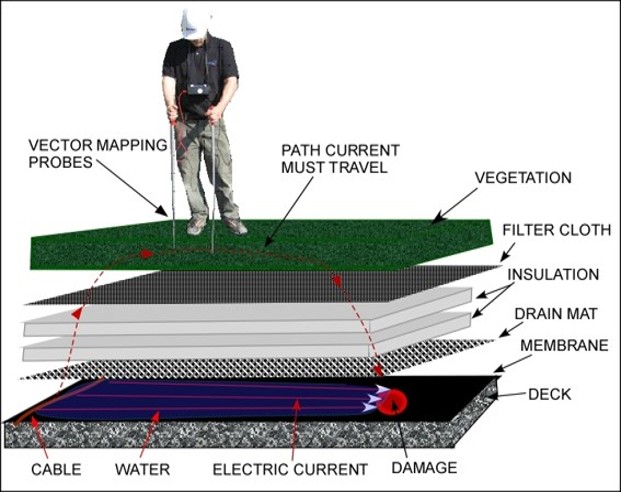
ASTM D7877 states that electrically insulating layers above the membrane—such as drain mats, root barriers, and insulation—block the electrical path required for testing. The vector mapping method also requires a continuous layer of water on the membrane surface, which cannot be confirmed beneath overburden.
Manufacturer’s technical bulletins have clearly stated:
-Electricity must travel from the top overburden surface to the conductive substrate.
-If the path is incomplete, breaches will not be detected.
-Overburden type and thickness directly affect accuracy.
For valid ELD testing, overburden must be removed and testing completed to pinpoint the breach. Science confirms that testing through overburden cannot be reliably validated.
#5 Misrepresentation of FM Approvals
Some testing agencies mislead the industry regarding having FM approvals for ELD.
FM requires:
-ELD manufacturers to obtain product approval. This includes a conductive medium, ELD testing equipment and continuously monitored systems.
-Membrane manufacturers to test assemblies including those products.
-Approved combinations to be listed within specific RoofNav assemblies.
Some testing agencies claim they have FM approvals with conductive mediums that are not actually listed in RoofNav. Also, some membrane manufacturers imply RoofNav compatibility with ELD where none exists. These false claims create confusion, can diminish specifications and decrease project sustainability.
Best practice is to verify documentation directly and rely on clear, enforceable specification language. ELD approvals for FM can be found in FM Approvals 7745.
Final Thoughts: Trust the Science
Electronic Leak Detection is not subjective. ELD is governed by physics and defined by ASTM standards.
Quality control testing must be:
-Scientifically valid
-Code compliant
-Fully transparent
Project teams should rely on documented standards, published technical bulletins, and verifiable approvals, not erroneous marketing claims which many ELD testing agencies make.
When ELD is performed correctly, it is one of the most powerful quality assurance tools available in roofing and waterproofing. When performed incorrectly, it becomes an expensive formality that provides invalid, useless information.
The industry deserves better.

Related Articles
-

Specifying Electronic Leak Detection (ELD): Best Practices in Division 07 Specifications
-
Electronic Leak Detection vs. Flood Testing: A Modern Standard for Waterproofing Integrity
-
The Conductive Medium Mistake Costing the Roofing Industry Billions
-
Building It Dry: The Case for Real-Time Moisture Monitoring During Construction