August 2026
For decades, flood testing has been used to evaluate the integrity of waterproofing membranes. The process involves ponding water over a horizontal surface for 24 to 72 hours, marking the water level, and monitoring for any drop that may indicate leakage. In some cases, areas beneath the deck are inspected for visible signs of water intrusion.
While widely practiced, flood testing has significant limitations, particularly when applied outside of its intended scope. Flood testing is not recommended in conventional roofing systems due to the added weight of standing water placing excessive loads on the structure, potentially causing damage to the roof assembly.
ASTM D5957, Standard Guide for Flood Testing Horizontal Waterproofing Installations, outlines the procedures, techniques, and limitations associated with flood testing. Importantly, this standard specifies that it is intended for waterproofing applications such as parking garages and plaza decks, not conventional roofing assemblies.
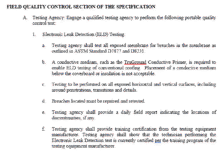
Recognizing advancements in technology and testing reliability, the ASTM committee is moving to incorporate Electronic Leak Detection (ELD) language into ASTM D5957 as the recommended method for verifying the integrity of waterproofing systems.
The Limitations of Flood Testing
Flood testing presents several practical and technical constraints:
-It can only work on horizontal surfaces.
-It cannot identify the precise location of breaches in the membrane.
-It does not determine the number of breaches present.
-It cannot assess vertical or complex detailing areas.
-Results may be influenced by environmental conditions such as evaporation or substrate absorption.
-It takes time and resources to build the structure and then wait 24 to 72 hours
-The weight of the water can damage the roof assembly
These limitations lead to uncertainty.
The Advantages of Electronic Leak Detection (ELD)
Electronic Leak Detection represents a modern, non-destructive, and highly accurate alternative. Unlike flood testing, ELD can evaluate 100% of the exposed membrane surface including horizontal and vertical applications.
Key benefits of ELD include:
-Precise pinpointing of breaches: Defects/voids in the membrane can be quickly and accurately located.
-Comprehensive testing: All exposed membrane areas can be evaluated. Testing can be performed on verticals, transitions, details and penetrations.
-Immediate repair verification: Breaches can be repaired and retested the same day.
-No structural loading concerns: Eliminates the risks associated with standing water weight.
-Efficiency: Large areas can typically be tested and breaches repaired if needed, within a standard 8-hour workday saving time and money.
-Water conservation: Significantly reduces water usage compared to traditional flood testing.
Rather than simply indicating that a leak may exist, ELD identifies exactly where the breach occurs, allowing for targeted repairs and greater confidence in membrane integrity.
A Shift Toward Best Practice
While flood testing may still have limited, appropriate applications in certain horizontal waterproofing assemblies, it is no longer considered a reliable or efficient method for verifying membrane integrity. Electronic Leak Detection (ELD) offers pinpoint accuracy, broader application capability, and improved risk mitigation.
For building owners, facility managers, consultants, architects, manufacturers and contractors seeking a dependable solution, ELD provides the only method capable of locating every breach before it develops into active interior leakage. As industry standards evolve, the transition from flood testing to ELD reflects a technical advancement in precision, performance, and long-term building protection.