July 2026
Specifying Electronic Leak Detection (ELD): Best Practices to Ensure Valid ELD for Roofing and Waterproofing in Division 07 Specifications
Electronic Leak Detection (ELD) has become an increasingly important component of modern roofing and waterproofing quality control testing. While best practice would include ELD in all new installations, it is still commonly introduced as a specification-driven scope, often appearing in Division 07 and carried out by a subcontractor.
Despite ELD’s growing use, confusion remains within the industry regarding proper specification language, terminology, and scope delineation. This confusion is often the result of:
-Limited familiarity with ELD testing methodologies
Overreliance on outdated or copy-and-pasted specifications
Proprietary language provided by testing agencies
Misuse of terminology such as “leak detection system”
To properly specify ELD, it is essential to understand the three distinct scopes:
-
ELD Quality Control (QC) Testing
-
Conductive Medium Requirements for Conventional Roofing
-
Continuously Monitored Leak Detection Systems
Each serves a different function and requires specific, clear specification language.
-
Electronic Leak Detection (ELD) Quality Control Testing
ELD QC testing is typically located in the Field Quality Control section of Division 07 roofing and waterproofing specifications. The language should be:
-Non-proprietary
-Independent of any specific testing agency
-Referenced directly to ASTM standards
-Clear about areas to be tested
The Governing Standards for ELD are:
-ASTM D7877 Standard Guide for Electronic Methods for Detecting and Locating Leaks in Waterproof Membranes
-ASTM D8231 Standard Practice for the Use of a Low-Voltage Electronic Scanning System for Detecting and Locating Breaches in Roofing and Waterproofing Membranes
These standards define the ELD testing methods, equipment, procedures, limitations, and reporting requirements. Specifications should reference these standards rather than restating them in detail.
Best-Practice ELD QC Testing Specification Language
Field Quality Control Section
Testing Agency: Engage a qualified testing agency to perform Electronic Leak Detection (ELD) quality control testing in accordance with ASTM D7877 and ASTM D8231.
-Testing shall be performed on all exposed membrane surfaces for breaches, including horizontals, verticals, transitions, details, and penetrations.
-Testing shall occur immediately prior to installation of overburden or prior to commencement of the warranty period.
-All identified breaches shall be marked, numbered, and photographed.
-Breaches located must be repaired and retested.
-The testing agency shall provide daily field reports documenting findings and corrective actions.
This language is clear, enforceable, and free from unnecessary or proprietary content.
-
Conductive Medium Requirements for Conventional Roofing
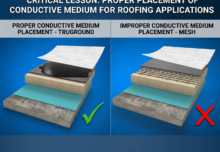
In conventional roofing assemblies, the substrate directly below the membrane is often non-conductive (such as a cover board). Because ELD requires an electrically grounded substrate directly beneath the membrane, a conductive medium must be specified.
This is one of the most frequently missed elements in roofing specifications requiring ELD. When omitted, the result is either invalid testing or deletion of the ELD scope altogether.
Conductive medium language should appear in the Materials or Accessories Section, and reinforced in the Field Quality Control Section
Best-Practice Conductive Medium Language
Conductive Medium for Electronic Leak Detection (ELD) Testing
-Install a conductive medium directly below the membrane to enable ELD quality control testing in accordance with ASTM D7877 and ASTM D8231.
-Placement below the coverboard or insulation is not acceptable.
Field Quality Control Section
Testing Agency: Engage a qualified testing agency to perform Electronic Leak Detection (ELD) quality control testing in accordance with ASTM D7877 and ASTM D8231.
-A conductive medium shall be installed directly below the membrane to enable ELD testing. Placement below the coverboard or insulation is not acceptable.
-Testing shall be performed immediately prior to covering with overburden or prior to warranty commencement.
-Testing shall be performed on all exposed membrane surfaces, including horizontals, verticals, transitions, details, and penetrations.
-Identified breaches shall be marked, numbered, photographed, repaired and retested to confirm membrane integrity.
-The testing agency shall provide daily field reports.
By clearly specifying conductive medium requirements for conventional roofing, designers ensure that valid ELD testing can be performed as intended.
-
Continuously Monitored Leak Detection Systems
The term “leak detection system” is frequently misused in specifications. The word system should only apply to permanently installed sensors connected to dedicated power and data for continuous monitoring. “Systems” are not QC tests. They are active monitoring systems designed to detect moisture intrusion in real-time. Clarity in terminology is critical. If the specification simply states, “leak detection system,” bidders may misinterpret whether the requirement is:
-Third-party QC testing, or
-A conductive medium, or
-A permanently installed monitoring system, or
-All the above
These are fundamentally different scopes with significantly different costs and functions.
Specification language for monitored systems typically appears in the Accessories or Materials Section and varies based on assembly type.
Best-Practice Continuously Monitored System Language
Conventional Roofing Assemblies
Continuously Monitored Moisture Detection System: Install continuously monitored moisture detection system within the roof assembly. Moisture monitoring shall begin during construction, and for the life of the roof. .
-Install sensors on top of the vapor barrier in a grid pattern.
-Areas must be roofed over the same day of installation to protect sensors from damage and moisture intrusion.
Inverted Waterproofing Assemblies
Continuously Monitored Breach Detection System: Install continuously monitored breach detection system on the surface of the waterproofing for continuous leak detection beneath overburden.
-Install sensors on top of the membrane in a grid pattern.
-Areas must be covered the same day of installation to prevent damage.
Key Takeaways for Specifiers
-Reference ASTM standards D7877 and D8231.
-Keep specification language non-proprietary.
-Require ELD QC testing on waterproofing in lieu of flood testing.
-Include conductive medium directly below the membrane for conventional roofing.
-Use the term “system” only for continuously monitored applications.
-Clearly define the scope of work.
Proper ELD specification ensures membrane integrity, protects warranties, and reduces long-term risk. Clear language eliminates confusion—and in roofing and waterproofing, clarity directly impacts cost and performance.